6-Step Approach to Achieve Operational Excellence
Author:
Alp Erguney
Updated:
February 25, 2026

Before we jump into the steps to eliminate operational shortcomings, let's set the stage with what's causing them.
What causes operational dysfunctions?
Operational issues rarely appear out of nowhere. They stem from;
- Vague roles and responsibilities that create grey areas where no one takes accountability. Over time, this erodes value.
- Redundant or manual processes which consume time on low-value activities and increase lead time.
- Unnecessary hand-offs that slow progress and introduce rework.
- Lack of shared knowledge which brings operations to a halt when key information sits with a few individuals.
How to make evidence-based decisions for continuous improvement?
I often see organisations shoot in the dark by relying on gut feel, or incomplete and inaccurate data. That approach doesn’t just slow improvement; it actively misleads it. This 6-stepped approach is not a list of to-do items but rather a framework to improve relentlessly.
1. Define the desired state
Start with clarity. What are you actually trying to achieve?
Not vague ambitions. Clear outcomes. If you can’t measure it, you won’t improve it effectively.
Define goals that are specific and time-bound. Make sure they align with the broader direction of the business. Otherwise, you optimise locally and miss the bigger picture.
A simple vision statement helps. So do a handful of meaningful metrics that tell you whether you’re getting closer or drifting away.
2. Understand the current state
Before changing anything, understand how things actually work today so you can prioritise based on potential gain.
Look at real data. Talk to people doing the work. Observe the flow end to end.
Relying on a single source can be misleading. Combine perspectives. Systems, people, inputs and outputs all matter in having holistic view.
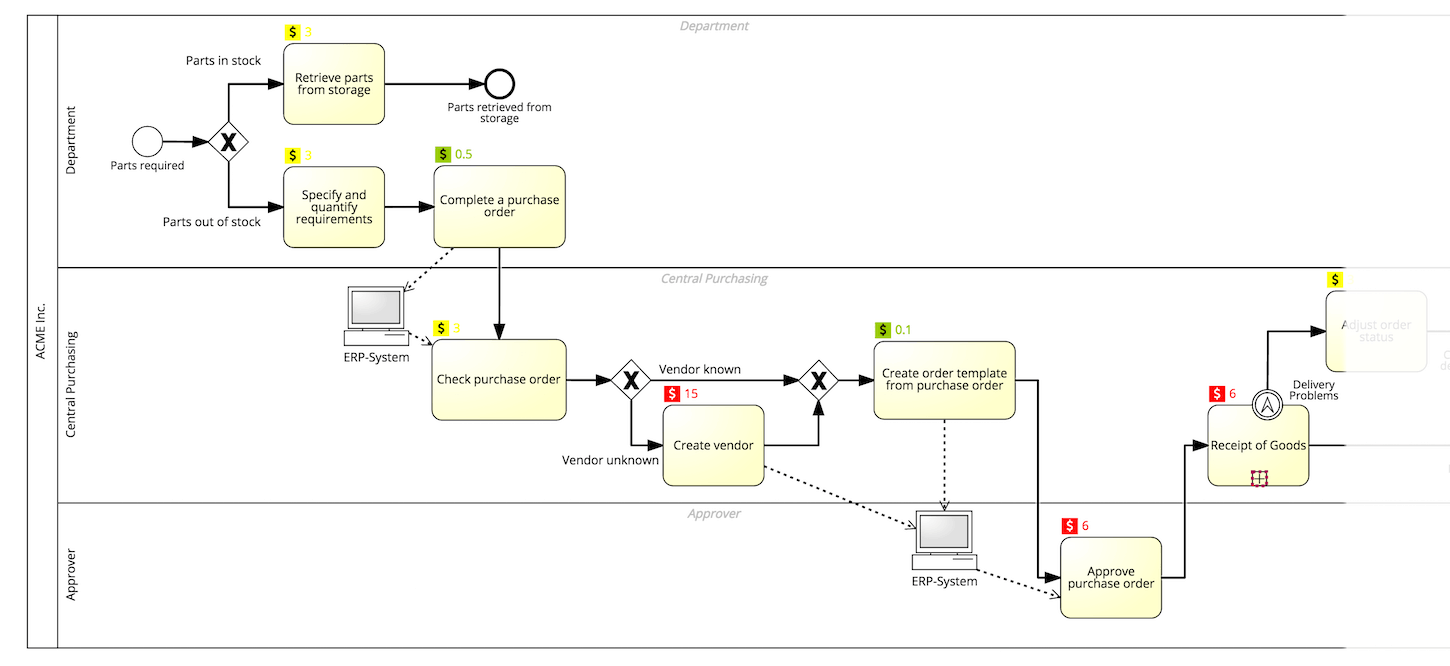
Using techniques such as value stream mapping or process modelling serve as an organisational X-ray. Most problems become obvious when you see the work, and improvements become quantifiable when they're measured through process mining and system integrations.
3. Analyse the gaps
Now compare reality with intent.
Where are you falling short? By how much? And more importantly, does it actually matter?
Not every gap is worth fixing. Prioritise based on impact, not noise.
This is where many teams go wrong. They try to fix everything and end up fixing nothing.
Pro Tip: If you're using SAP Signavio, you can compare the as-is state with the to-be state for gap analysis by using version control.
4. Find the root causes
Gaps are symptoms. Don’t stop there.
Ask why, repeatedly, until you get to something you can actually act on.
If the cause isn’t specific, measurable, and testable, you are probably still too shallow.
Be careful here. Assumptions creep in fast. Validate your thinking before you act on it. Build continuous feedback mechanisms.
Pro Tip: You can simulate different scenarios using SAP Signavio.
5. Develop action plans
Now you are ready to act.
Every action should tie back to a root cause. If it doesn’t, it is just activity.
Be clear on who is doing what, and by when. Keep it realistic. Overloaded plans don’t get executed. Identify small but valuable areas to focus on. In other words, identify your Kaizen bursts.
Think about risks. Most plans fail not because they are wrong, but because they ignore what could go wrong for too long.
6. Implement and monitor
Execution is where most of this falls apart.
Track progress using the metrics you defined earlier. Don’t wait until the end. Course correct as you go.
If nothing changes in the numbers, it's either nothing has improved or your measurement is off. It is that simple.
So ask yourself, are you fixing root causes, or just getting better at living with the symptoms?
Final Thoughts
Operational excellence is not a destination, it's an ongoing journey that requires continuous adaptation.
Consistency matters. Small adjustments, made regularly, beat big resets that never happen.
I hope you enjoyed reading this. Stay tuned for the next article.